ADVICE & EXPLANATION
Welltherm infrared heating
With Welltherm infrared heating, you combine pleasant radiant warmth with panels suited to your interior. We help determine which version, mounting position and controls suit your home or business.
How infrared heating works
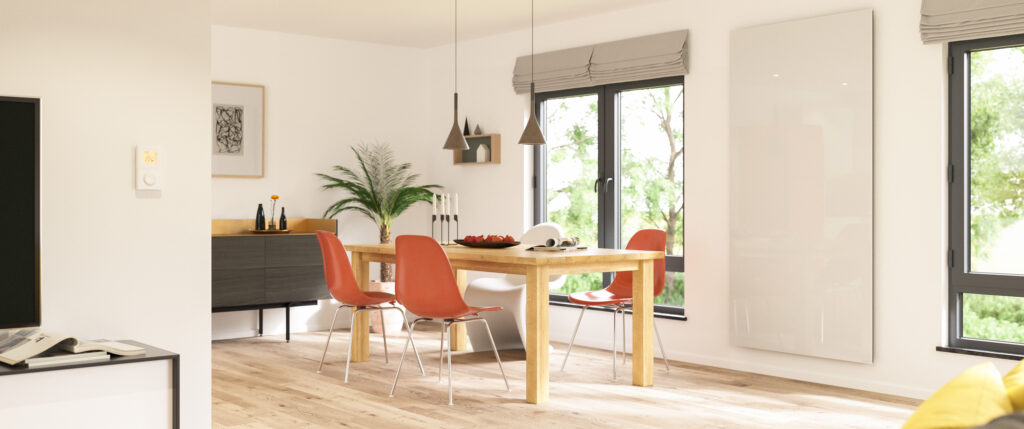
An infrared panel converts electricity into heat. Its warm front emits radiant heat towards people and surfaces within reach. The panel also transfers heat to the air. Heated floors, walls and furniture then contribute to the room’s temperature. The balance between these forms of heat depends on the panel and conditions.
You can compare direct warmth with the sensation of warmth from the sun. Heating panels do not produce sunlight. Positioning, distance and obstacles determine how much direct warmth you experience. A panel behind a cupboard or curtain may not sufficiently reach the intended position.
Designer infrared panels in glass and metal
A Welltherm infrared panel can provide a discreet feature on a wall, or a mirror, chalkboard or image within the interior. Glass panels come in various finishes. Metal panels offer a white front, RAL colour or personal image, among other options.
First determine which room you want to heat. Then select suitable material and finish. Consult the infrared panel overview for specifications by version. An attractive panel also needs appropriate output and a suitable mounting position.
Infrared heating on a wall or ceiling
Wall and ceiling mounting offer different interior possibilities. The chosen model’s manual specifies permitted mounting. Use fixings suitable for the supporting surface and maintain prescribed clearances from other materials.
In a bathroom, protection rating and mounting zone also matter. For a workstation, targeted warmth and separate controls may be useful. A high-ceilinged space or yoga studio requires an individual assessment. Explore our solutions for bathrooms, businesses and hot yoga.
Primary heating or supplementary warmth?
Whether infrared can provide your primary heating depends on the building’s heat loss. Floor area alone is insufficient: insulation, glazing, ceiling height, ventilation and desired temperature also matter. Have the required output determined for the room.
As supplementary heating, a panel can support a frequently used area, such as a bathroom or study. For an entire home, heating capacity must match use across all rooms. A heating plan prevents selecting solely from a broad rule of thumb. For other room functions, also explore preparation for infrared heating in a garden room and Welltherm heating in a garden building. You can then discuss your layout and intended use specifically with us.
Consumption and thermostatic controls
Electricity consumption follows from electrical output and the time the panels actually heat. A thermostat switches heating according to temperature and settings. Good insulation and suitable controls limit unnecessary heating.
Compare consumption using your electricity tariff and usage pattern. There is no savings percentage that applies to every home. Consult our consumption and costs page and choose a thermostat suited to the panels and installation.
A suitable version starts with your situation
Send dimensions, information about insulation and existing heating, and optionally a photograph or floor plan. You can enquire even if not everything is known yet. We help you make choices and specify suitable products and controls in your quotation.
Want to experience the versions first? Explore dealer locations and contact them beforehand about availability and visits. The specific model’s instructions remain authoritative for mounting and use.
Welltherm infrared heating based on clear heating requirements
Welltherm infrared heating becomes most concrete when you first describe what should change in the room. Do you want a cold reading position to feel more pleasant, to heat a separate study or to provide all warmth for a living room? These are different tasks. Someone retaining an existing radiator may receive a different proposal from someone replacing the room’s entire heating system. Identifying the objective beforehand lets us compare products according to their actual role.
Read more
Next consider when that warmth is wanted. A study may be used on three fixed days; a reception area has another rhythm; a bathroom often needs comfort around a regular morning routine. Record the normal week and exceptions. This provides a better basis for controls than merely selecting the maximum hours heating can operate. Panel capacity and programme are assessed together for that usage requirement.
A pleasant sensation in one position is useful experience, but not proof that the entire room has enough capacity. A primary heating installation must compensate for heat loss under the desired conditions. For supplementary heating, a particular occupied zone may instead be central. Make clear in your enquiry which existing heat source remains and what the new panels should add. This avoids comparing proposals delivering different functions.
The interior also indicates heating requirements. A sofa against an external wall, a desk near a large window or a frequently opened door may influence conditions around the user. Mark those positions too. Sometimes another panel position is useful; sometimes improving draught sealing or insulation is an important part of the same plan. Heating is then selected according to the room where it is used, rather than a standalone product name.
Compare current panel families purposefully
For a discreet metal version, our collection includes white panels and separate finish groups for sand, graphite, RAL colour and images, among others. The metal PB range has its own dimensions, weights and outputs. A nominal size name is not always the exact external dimension. Use article data to assess how a panel fits the desired position. Colour or image proposals then follow within a version suited to the room.
Specific products are available for special applications, such as ST0100 desk heating, CB pew heating and HT1401 for suitable high-ceilinged indoor spaces. Ceramic HP heaters likewise have their own application and mounting requirements. High output alone does not establish that such an appliance is right for a living room. First examine the operating environment and intended heat transfer. We then compare the relevant series, dimensions, connections and controls.
Read more
Within glass, assess the satin Satino version, mirror series and black writable Tafel panel according to their different functions. A mirror adds daily mirror use; a chalkboard has a purpose-designed writable surface. The higher-output Satino PRO series is a separate ceiling choice. A similar glass appearance is therefore no reason to interchange output, permitted mounting or accompanying components between these series.
Bathroom panels with a towel function form their own product group. The BP version combines a lower towel zone with an upper room-heating zone. This makes it a different selection from an ordinary wall panel in the same colour. A desired towel function is selected with the series and compatible rails. Mention that requirement at the design stage so output, accessibility and the bathroom’s electrical assessment are included in the same selection.
From room data to a practical design
Measure the room’s length, width and actual height. Add glazing and external wall areas and describe the insulation you know about. Different heights matter in an attic or tall room. A sloping roof can change volume and distance to a panel compared with a rectangular room of the same floor area. A simple cross-section helps prepare the design without requiring you to perform a complete technical calculation yourself.
Read more
State unknown information honestly. If the construction year is known but roof insulation thickness is not, record that distinction. A precise-looking wattage based on uncertain assumptions offers little guidance. Describe what you can actually establish and add photographs of windows, mounting surfaces and existing heating. We can then determine what further information is needed before choosing a version or having an installer develop the plan further.
A catalogue floor area is an orientation aid. Two rooms with identical floor areas may have different heat losses due to glazing, position and ventilation. Desired temperature may also differ. Use an indication to explore product options, not as a complete guarantee that one chosen panel is always enough. In our proposal, we connect product specifications to your room’s described conditions and the installation’s task.
With several panels, distribution matters too. One large heat source and a combination of smaller panels may have the same nominal capacity but offer different positioning and heat direction. Consider seating positions, obstacles and possible connection points. A complete comparison identifies both output and positions. You can then understand why a proposal includes several appliances or one purposefully selected version.
Mounting and interior design as one preparation
For wall mounting, preserve a useful heat direction and sufficient clear space. Consider door swing, curtains, cupboards and people moving past the appliance. The warm surface is not a storage area or place to hang clothes. Assess those daily activities before fixing the position. An empty wall area on a construction drawing may later be blocked by furniture; the final interior therefore already belongs in preparation.
Read more
A ceiling position can keep wall space available. The selected panel must permit that mounting, and the structure must support its weight using the prescribed fixings. Model-specific retaining components belong in the choice for glass ceiling panels. A recessed frame requires its own preparation of the opening and supporting structure. Do not treat these mounting forms as interchangeable names for the same installation: each combination has its own requirements and components.
Cable routing deserves attention before finishing. A receiver may need a different suitable position from the panel or thermostat. Have fixed connections and work on open cable ends carried out professionally. During renovation, record which provisions remain visible and which go behind an accessible finish. A tidy appearance is then combined with an installation that can later be inspected without unnecessary wall or ceiling repairs.
In a bathroom, mounting position is assessed for the exact product and complete electrical arrangement. The panel’s protection rating does not automatically apply to a thermostat, connection point or LED frame. A bathroom image does not authorise the same position in your room. Use the model manual and have shower, bath, water points and connections assessed together on the sketch. This is a practical part of selection, not a step arising only after purchase.
An understandable programme and realistic electricity use
A thermostat follows measured temperature and commands the appropriate switching component. The measurement location must therefore represent the room in use. Direct sunlight, local heat or draughts can affect the result. Select the sensor location together with panel position so attractive mounting does not accompany impractical controls. When several users share controls, a fixed agreed measurement position is also easier to understand than a constantly moved sensor.
For energy consumption, multiply output in kilowatts by actual operating time. As a clear calculation example, a 500-watt panel heating continuously for two hours uses one kilowatt-hour. This example is not output advice or a prediction of a normal day. A programme may be active longer while the thermostat switches off intermittently. Measurements therefore provide more insight than a standard number of operating hours without information about room and settings.
Read more
A weekly programme fits regular operating times. However, warming the panel and room takes time. Check practically how much preparation suits the room. A completely cooled room responds differently from one with an existing background temperature. Keep temporary changes clear and check how controls return to the normal setting. The programme then becomes a tool for your routine rather than a collection of settings nobody recognises anymore.
When comparing, consider the same heating function. Local workstation heating delivers something different from primary heating throughout a home. Gas, a heat pump and direct electric panels also have different heat-supply arrangements. Include the complete installation, tariffs and desired conditions. Solar electricity may contribute when production and heating coincide, but annual generation totals do not prove that winter heating demand is always covered by that electricity.
Make quality, maintenance and support concrete
Welltherm develops and manufactures infrared heating systems in Lüdenscheid. We connect panel selection with technical information for the relevant series. Materials, finish and product documentation help assess which appliance suits your application. A quality label or technology designation is always connected to the products to which that information relates. It does not replace a suitable heating plan or mounting requirements for a special room.
HeatXL handles Welltherm distribution in the Benelux. Explore HeatXL for product selection and support. Available retail prices are listed in the Welltherm webshop at infraroodpaneel.nl (Opens in a new tab). For a complete room or home, a proposal including panels, components and described preparation is useful, allowing you to compare different solutions for the same heating task.
Read more
Even a simple installation needs attention over a long period of use. Follow cleaning instructions, allow the appliance to cool for maintenance and keep cables, fixings and controls in good condition. After rearranging furniture, check that the radiant area and prescribed clearance remain. Keep article codes and documentation with purchase records. A later product enquiry can then be addressed specifically without relying solely on a lifestyle photograph.
Warranty provisions differ between product groups and components. For relevant panels, the applicable period is considered according to conditions; a control component, accessory or specialist heater does not automatically receive the same warranty. Request conditions for the combination actually selected. A warranty period describes conditional support and is not a fixed promise of total lifespan or unrestricted use in every environment.
An enquiry that helps you progress purposefully
A good initial enquiry includes the room’s purpose, dimensions and photographs of possible mounting positions. State which existing heating remains and when you use the room. Add preferences for white, mirror, colour or images, while connecting them to the room’s function. Even if the final interior is not settled, we can discuss possible mounting positions and product options using that information.
The official Welltherm metal panel manual is available for preparing metal panels. For glass and specialist products, use their own documentation through downloads and manuals. Installation videos in our video help can explain procedures but do not replace your model’s instructions. Always have the professional carrying out work assess the chosen combination against the actual supporting surface.
Read more
Ask about the assumptions used in the proposal. Which temperature and usage function are intended, how are panels distributed and which components belong to the connection? For renovation, also establish what work the installer prepares and when the ceiling or wall can be finished. These agreements provide more insight than a list containing only article numbers and individual prices.
After installation, the system is checked and controls adapted to use. Test whether each zone operates the intended panels, restore normal settings after testing and record your experience during the first period. Where something differs, we assess capacity, positioning, measurement location and programme together. Welltherm infrared heating then gains a concrete role in your home or business: a suitable solution with clear information for use and support.
How infrared warmth spreads through your room
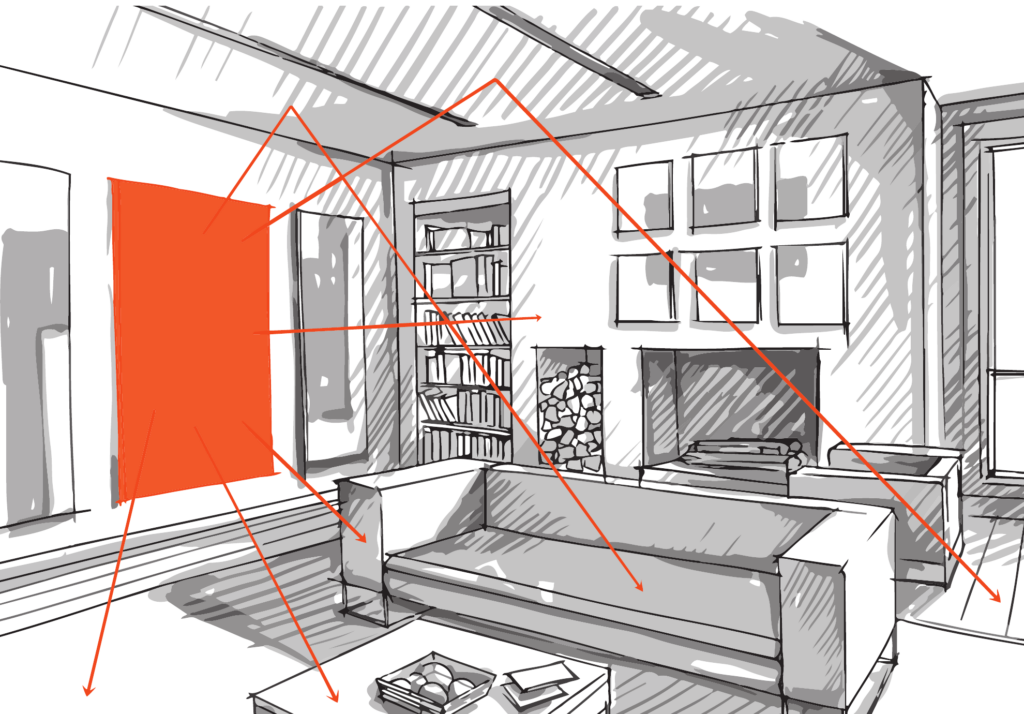
A Welltherm infrared panel converts electrical energy into heat. Its warm surface emits part of that energy as infrared radiation. People and surfaces receiving the radiation absorb that energy and become warmer. You experience warmth where you spend time.
Walls, floors and furniture subsequently release absorbed heat to their surroundings. The air in the room therefore warms too. A panel also transfers heat by convection. The balance between these forms depends on factors including version, surface temperature and mounting.
We therefore choose output and positioning together. An unobstructed view between the panel and zone to be heated helps bring radiant warmth to the right position. Insulation and heat loss remain decisive for how much heat your room needs.
ESHC Plus: technology inside the panel
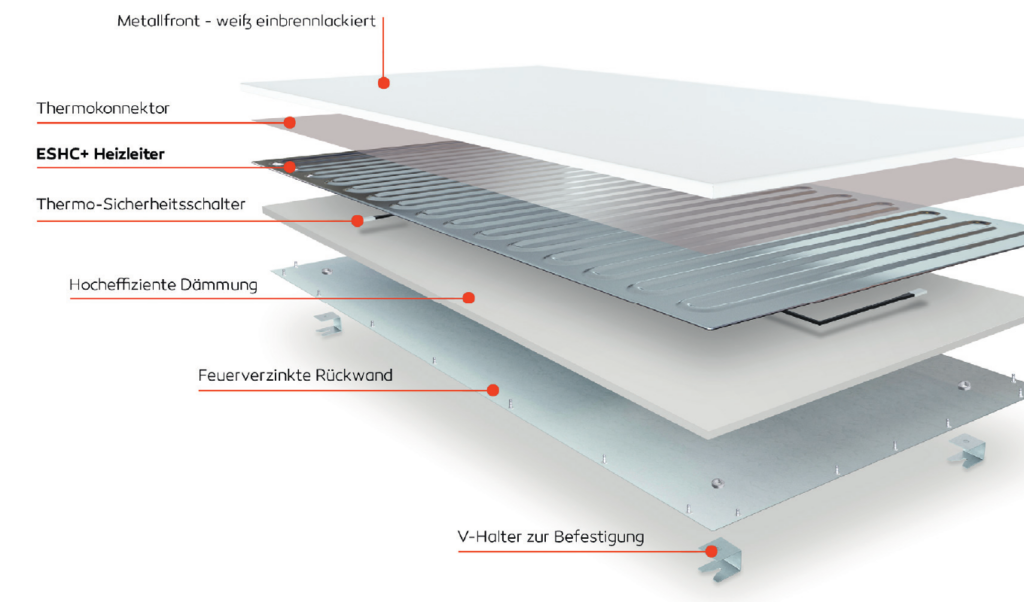
Our ESHC Plus technology uses a heating layer across the panel surface. The design brings heat to the front, while rear insulation limits heat emission backwards. Front, heating layer, safety components, insulation and housing together form the panel.
The technical cross-section shows a metal version. Labels in the original image are in German: metal front, thermoconnector, ESHC Plus heating layer, thermal protection, insulation, galvanised rear panel and mounting brackets. Glass and specialist versions have their own construction and specifications.
A short warm-up time can be practical for rooms used at particular times. The time needed to reach the desired room temperature then depends on selected output and the room. Suitable thermostats and timed programmes adapt heating demand to your use.
What does this mean for your energy costs?
Consumption follows from electrical output and the time a panel actually heats. A thermostat switches according to heating demand. Positioning, insulation, desired temperature and operating duration together determine the result. We therefore calculate according to your room and use, rather than promising one fixed savings percentage for every home. For your preparation, you can explore how long-wave warmth works. Want to learn more about comfort and conditions for appropriate use? Read our explanation of thermal comfort, health and careful use.