Welltherm · knowledge & inspiration
Welltherm heating with a plug: complete guide
21 July 2026 · Welltherm Netherlands / HeatXL

For Welltherm heating with a plug, first establish which plug system is meant. A standard mains plug and a Precon connector serve different functions. Selection therefore concerns not just connecting a cable but the complete combination of panel, suitable controls and electrical provision.
Key points
- Distinguish an ordinary mains plug from the Precon system for compatible connecting and control components.
- Have panel, thermostat, receiver and electrical provision selected as a complete combination.
- ST0100 is a dedicated local desk product with a Schuko plug and inline dimmer.
- Mounting conditions, heat loss and surroundings remain relevant with a plug connection.
- Compare costs using output and actual operating time, and request pricing for the complete combination.
We help distinguish these components clearly. Discover how a local desk product differs from room heating, which connecting components our catalogue describes and how to tailor the proposal to your room. Welltherm NL and HeatXL connect product selection with mounting and operation so you know exactly what the offered solution includes.
A plug describes the connection, not the whole system
Schuko and Precon each have their own role
A Schuko plug is the mains plug type used with products or connecting components intended for it. Precon is Welltherm’s connection concept linking compatible heating and control components. Describing a product as Precon therefore does not mean its panel cable automatically has an ordinary socket plug.
For the relevant standard infrared heating systems, our 2026 catalogue describes a preconfigured 650-millimetre connecting cable with a three-pole GST15i3 connector. That connection belongs to the selected system arrangement. Product series and article number determine which data apply to your version. Seeing these details in a quotation is more useful than the word plug alone.
Read more
The final mains connection may differ according to the combination. Specific components exist for a suitable plug version and for other connection methods. Select panel, controls and connection together. This clarifies required cables and receivers and which electrical work belongs to implementation.
Why controls belong in the selection
A heating panel provides warmth when switched on. Suitable controls determine when and how the room reaches its set temperature. The connector alone does not perform that task. An adapter allowing physical connection is not by itself a temperature programme or complete control solution.
Discuss the complete combination beforehand. Where is temperature measured, which component switches the panel and how do you set operating periods? These answers give the system an understandable function. Our Precon connections and controls page helps explore the components further.
Read more
The catalogue connects the described Precon system arrangement with suitable controls for the relevant heating products. Use the prescribed combination and instructions. We do not infer suitability or required operation solely from a connector’s presence. The final version must support the specific product and intended application.
A socket does not replace electrical assessment
An existing connection may be a useful starting point but must suit the installation. Total output and other connected appliances matter. Have a qualified professional assess whether provision is usable and which version is required. A specific assessment is important for new fixed connections, altered installations or uncertainty about the situation.
Read more
Also examine accessibility and cable routing. A panel should occupy a useful heating position, not merely somewhere near a convenient socket. A cable crossing a circulation route, a cupboard covering the connection or a receiver without suitable mounting space may make implementation impractical. Include these details during product selection.
A plug connection does not automatically make a product movable or suitable for every room. Mounting, clearances and intended environment remain separate requirements. Do not use a fixed wall panel loose against furniture merely because its cable is long enough. Connection is one part of the product version alongside how the appliance is used.

Choose the heating product according to its function
A room panel provides warmth to people and surfaces
An infrared panel converts electricity into heat and radiates it through its warm surface. People and surfaces receiving that energy may consequently feel warmer. Heated surfaces subsequently transfer heat to the surroundings, including air. With suitable capacity and positioning, this operation can form part of heating an entire room.
The connection principle does not change that heating demand. A plugged-in panel still needs warm-up time and must match the room’s heat loss. A cold room does not automatically become comfortable everywhere immediately. A timed programme can allow for desired lead time. For a regularly used room, this coordination is often more practical than manual switching alone.
For primary heating, we assess total output and the room. For supplementary warmth, a panel may have a smaller, targeted task. Clarify this distinction before selecting a version. The same product dimensions are not automatically suitable for both functions, even when connection can be organised simply.
ST0100 has an explicitly specified Schuko version
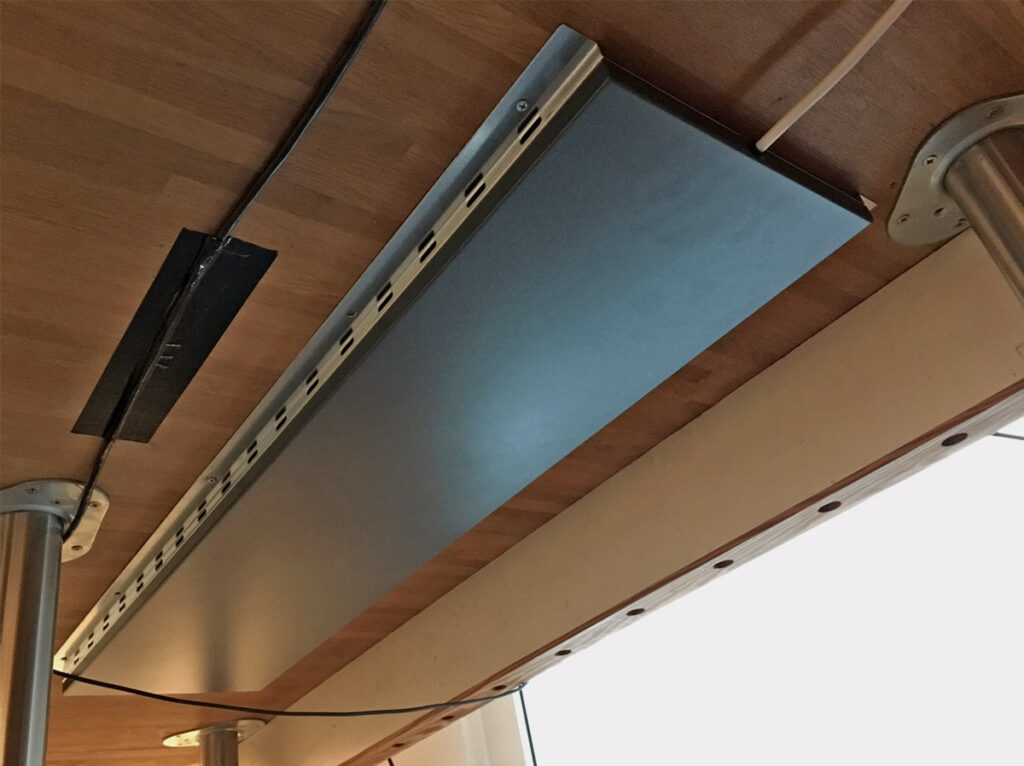
Our catalogue describes ST0100 desk heating with 100 watts, dimensions of 30 by 60 centimetres and a weight of 3.8 kilograms. Its protection designation is IP21. This specific version lists a black 1850-millimetre cable with a continuously adjustable inline dimmer and Schuko plug. It is a concrete example of a product with a documented mains plug.
These details apply to ST0100 and are not automatically transferred to all Welltherm panels. The desk product also has a local function. Its 100-watt output is not a calculation for the whole study’s heating demand. State whether you want desk comfort or independent room heating so the product category matches.
The inline dimmer controls the local product’s operation but serves a different function from a room thermostat monitoring the desired room temperature. Keep these controls distinct in your expectations. Explore our infrared desk heating if this particular application matches your enquiry.
Compare other electric heating for the same task
A fan heater, convector and infrared panel may transfer heat in different ways. Compare them according to your desired function, positioning and controls. Nominal output indicates electrical power used in the relevant operation; it does not independently determine which system gives the lowest total consumption in your situation.
Explore Welltherm’s complete infrared panel collection and product-specific connection data. Glass, metal, mirror and other finishes can serve a role within suitable series. Front material or colour does not determine the required connecting component. The particular version remains the starting point for technical selection.
Read more
A local heat product and primary heating do not perform equivalent tasks. A small appliance may consume little electricity while warming only one location. This cannot be directly compared with costs for an entire room. Describe identical operating hours and desired comfort so functional differences are not interpreted as general savings.
Combine panel, receiver and controls
Distinguish temperature measurement from switching
A room thermostat measures temperature and compares it with the set value. A compatible receiver or switching provision then operates the heating. These tasks may be assigned to separate system components. A wireless thermostat therefore does not mean the entire heating product works without an electrical cable.
Read more
For the relevant controls, the catalogue describes a thermostat for the room and receiver for the heating product. Have the specific arrangement confirmed for your combination, especially with multiple panels. It must be clear which appliances are controlled together and which component switches them. This makes installation and daily operation easier to assess.
An existing central-heating thermostat cannot necessarily operate electric panels. The signal, function and required switching provision must match. Provide your current controls if you want a combination assessed. Select additional components according to the outcome rather than assuming all thermostats have the same heating connection.
Connecting components in the catalogue
Our catalogue’s Precon components have their own connection methods. PC0001 is described as a 500-millimetre cable with a three-pole GST15i3 connection at one end and stripped cable ends at the other for the relevant connection. PC0010 is an 1800-millimetre connecting cable with GST15i3 and a flat Schuko plug. These components are selected for a suitable combination.
The presence of PC0010 is not a reason to omit required controls. The component describes a connection, while the complete system function follows from several details. Have the components belonging together with the chosen panel documented. A qualified professional assesses connecting component and any receiver positions.
Read more
The catalogue also lists specific receiver versions, including variants with different connection options. A receiver with a suitable preassembled connection is not the same article as a direct-connection version. Compare the full article description. This prevents advice about one variant being implemented later with a differently connected component.
Choose controls you genuinely use
A weekly programme can adapt heating to hours spent working at home, showering or sitting in the living room. Select functions according to that routine. A simple programme you understand may be more practical than many possibilities requiring help each time. Also discuss how a temporary adjustment returns to the normal setting.
App controls and other smart functions are selected within specific systems. The catalogue lists possibilities for relevant control series, but not every panel and accessory combination offers identical functions. Have the quotation establish which controls and any connections are actually available. Our thermostats page provides a starting point for selection.
Read more
Measurement position belongs in the selection. Direct heat near the panel, sunlight or a cold external wall may affect readings. Use thermostat mounting instructions and select a representative location. If you feel cold elsewhere, discuss room conditions and heat distribution before continually increasing the temperature setting.

Connect mounting and capacity with the connection
For a quotation, make a short component list with three columns: chosen panel, controls and connections. Record each article number and function. You can then see whether a description concerns only a cable or also includes a receiver. For a package, request the same information for individual components. This helps compare two proposals and avoids directly comparing prices for different combinations. The complete list can then be used during installation and for operating enquiries.
Also check how the combination is switched on and reset during daily use. Perhaps you want only a fixed weekly schedule, while another household often needs temporary changes. Ask which action is needed and where to perform it. A clear answer is more practical than merely listing a smart function on a product card. Include special preferences, such as operation without a phone or an easily accessible thermostat, early in the enquiry.
The room determines required output
Measure length, width and height and specify external walls, windows and known insulation. State the desired temperature and normal use. Ventilation and adjoining rooms are also relevant. These details allow suitable capacity to be assessed. Connection through a plug does not change heating demand.
Read more
A fixed wattage for a twenty-square-metre room is not personal advice. Differences in glazing, insulation and height can have considerable influence. Catalogue indications help orientation but are connected to your conditions. Clearly identify unknown building data so the proposal can be based on sufficient information.
For complete primary heating across several rooms, the plan must be assessed per room and for the electrical installation as a whole. A few products with socket plugs do not automatically form complete home heating. Total capacity, distribution, controls and connection options belong together in the proposal.
A suitable wall or ceiling position
A panel must transfer warmth usefully towards the intended location. A large cupboard, thick curtains or open door may affect the selected position. Start with the occupied zone and interior. Then consider how connections can be arranged appropriately at that mounting position.
Read more
Wall and ceiling mounting are possible only within the chosen model’s conditions. The supporting surface must carry the weight and preserve prescribed clearance. A plug does not make mechanical mounting less important. Also assess whether cable and receiver remain accessible without disturbing the interior.
For freestanding or mobile use, select a purpose-designed combination with correct accessories. Standing a wall panel loose is not a general usage method. Product selection must support stability and mounting conditions. Explicitly state your wish to move it so the proposal describes the intended arrangement.
Electrical provision and surroundings
For multiple panels, have combined output and other connected appliances assessed. A receiver specification does not by itself establish what your electrical installation can support. A qualified professional assesses complete provision and desired switching. This is more useful than specifying a general maximum number of panels on one circuit.
The environment matters too. A bathroom, open veranda or other humid location needs its own product and installation selection. A Schuko or Precon connection does not establish general suitability for water or outdoor conditions. Have the exact version, mounting position and control components assessed together when the space has such conditions.
Read more
Use cables and components according to their specific instructions. Avoid cords in circulation routes or trapped by moving furniture. With an adjustable desk, assess the route in every operating position. An additional extension or distribution solution does not become a permanent heating component without assessment merely because distance is otherwise inconvenient.
Assess consumption and a complete quotation
Calculate using output and actual heating hours
As a purely hypothetical example, consider a 700-watt panel heating at full nominal output for a total of three hours in a day. Consumption is 0.7 kW multiplied by 3 hours: 2.1 kWh. With an illustrative tariff chosen as €0.30 per kWh, variable electricity costs are €0.63. This scenario is not product advice or a prediction for your room.
A connection type does not automatically change consumption. Heating demand, output and controls affect it. Explore our explanation of Welltherm infrared heating consumption and enter your own tariff. When comparing costs with other heating, compare the complete situation for the same comfort requirement.
Read more
The time a programme is active need not equal actual operating time. A thermostat may switch off intermittently; conditions determine how often. We therefore do not use a fixed halving or other percentage without measurements. Measured information or a clear usage scenario provides a better basis for a personal cost estimate.
Assess solar panels and targeted controls practically
Solar panels may generate electricity during heating hours. How much is available depends on weather, season and other consumers. A daytime workstation may have another pattern from an evening living room. Use your own generation data and electricity contract for comparison. Solar panels do not automatically make electric heating free to run.
Read more
Controlling a room separately can adapt the programme to actual use. This is particularly practical when rooms have different heating periods. It does not produce a fixed savings percentage applying to every home. The old situation, new settings and quantity of heat used determine the cost difference.
System selection includes characteristics beyond consumption. Consider desired appearance, mounting, controls and the role of existing heating. A suitable proposal makes these considerations visible. You can then assess why a panel and controls suit your room and which data support financial comparison.
Conditions, maintenance and quotation details
A panel’s surface can become hot. Keep textiles and other materials at the prescribed distance and do not cover the appliance. Clean according to instructions and allow the product to cool first. A plug does not replace checks of cables, fixings and clearance. After changing furniture, continue checking whether the arrangement still fits the original plan.
Applicable Welltherm panels carry a five-year warranty under accompanying conditions. Accessories may have different provisions. Consult our warranty page and have the conditions for the selected combination confirmed. Conditions relate to the specific product and correct use.
Send room details, photographs, operating hours and the existing connection with your enquiry. Specify the desired heating function and preferred controls. Prices in our shop are available on request. Request the complete panel, control and connecting-component combination so we and HeatXL can prepare a clear proposal.
Choose the complete combination behind the plug
Welltherm heating with a plug starts by distinguishing a mains plug from the Precon connection concept. Then select the product according to the desired heating function. A local ST0100 desk product with Schuko and inline dimmer serves a different task from a room panel with a suitable thermostat and receiver.
Want to know how your room and connections can work together? Send photographs, dimensions and preferences through request a quotation. We help document panel, mounting, controls and electrical arrangement as one proposal.
Frequently asked questions about Welltherm with a plug
Does every Welltherm panel have an ordinary socket plug?
No. The catalogue describes different connections and products. Compatible standard systems use Precon with GST15i3; ST0100 specifically has a Schuko plug. Have the article and complete connection combination identified in the proposal.
What is the difference between Precon and Schuko?
Precon is Welltherm’s concept for linking compatible heating and control components. Schuko describes a mains plug type. They play different roles in the system. A connector alone does not determine which controls or installation the product needs.
What does the PC0010 connecting cable do?
The catalogue describes PC0010 as an 1800-millimetre cable with a three-pole GST15i3 connection and flat Schuko plug. It is a specific connecting component. A compatible control combination and operating conditions remain necessary for the particular product.
Can my central-heating thermostat switch the panels?
This cannot be assumed generally. The panel needs suitable controls and switching provision. Identify your current thermostat if assessing a combination. The selected receiver and connected output must suit the final arrangement.
Can I use several panels on one connection?
Have combined output, other appliances and the electrical installation assessed by a qualified professional. A general maximum quantity is insufficient because panels have different outputs. Selected controls and connection methods are assessed together with provision.
Is ST0100 intended to heat my room?
ST0100 is a local 100-watt desk product with dimensions of 30 by 60 centimetres, IP21, a weight of 3.8 kilograms and an inline dimmer. It has a specific desk-related task. For independent room heating, complete heating demand must be assessed separately.
Can plug-in heating provide primary heating?
A suitable heating system can be assessed for that role, but the plug itself says nothing about capacity. Heat loss, positioning and controls must suit each room. For several rooms, the complete electrical arrangement also belongs in the plan.
Is heating through a plug cheaper than gas?
Cost differences depend on the complete situation. Calculate electricity consumption from output and actual operating time using your own tariff. Compare the same heating function and comfort hours, including any changes in other rooms. Connections alone provide no general savings.