Documented quality
EIHA infrared heating quality label: our metal PB series
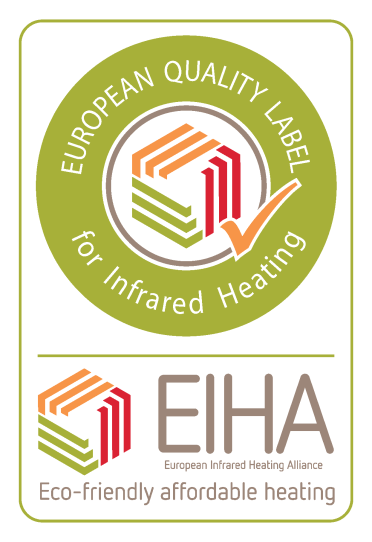
Our metal infrared panels in the PB series carry the European Quality Label for Infrared Heating. This makes the quality of this series visible and verifiable.
The EIHA quality label combines requirements for product safety, production control and radiant efficiency. The Welltherm PB series was assessed by Peutz; the certificate was issued by the Indoor Climate Center / Binnenklimaattechniek.
What does the EIHA quality label tell you?
Infrared heating involves more than the electrical output on the rating plate. Among other things, the label considers radiant performance according to IEC 60675-3:2020, supporting evidence for product safety and control of the production process. It provides a substantive basis for comparing a certified product series.
Radiant efficiency and comfort
Radiant efficiency describes the proportion of supplied energy emitted as radiant heat under the specified measurement conditions. It is a different quantity from your annual energy savings. Insulation, panel output, positioning and controls also determine how much heating your room needs. We bring these elements together in a suitable heating plan.
Which Welltherm products does the certificate cover?
Certificate 2412-004 identifies the metal infrared panels of the PB series. This product scope matters: glass versions, heaters and accessories are different product groups with their own documentation. You can consult the certificate and official register yourself on this page.
The published certificate is valid up to and including 23 December 2026.
This EIHA document was issued on 18 December 2024 under label version 01/2024. It states, among other things, assessment according to IEC 60675-3:2020 and refers to Regulation 2015/1188 for ecodesign. For a current panel and control combination, we also use the applicable product documentation and the ecodesign rules of Regulation 2024/1103. The certificate does not replace an assessment of your installation.
From quality to a suitable installation
A certified panel performs its role with a suitable mounting position and controls. With our precon plug system, we select the panel, connection components and thermostat as a coordinated system. HeatXL helps you in the Benelux with product selection, quotations and support.
Read how precon and controls work together →Quality management and other product markings
We develop and manufacture our infrared panels in Lüdenscheid. The catalogue also shows quality features such as ISO 9001:2015, TÜV Rheinland, GS and CE. Each has its own meaning; a catalogue image does not confirm the current validity or product scope of every document.
ISO 9001:2015 concerns the organisation’s quality management. GS stands for tested product safety; testing documents identify the assessed version. TÜV refers to a testing or certification body. CE is the conformity marking for the applicable European requirements. The ecodesign symbol refers to requirements for the appliance and suitable controls. Our product pages and accompanying documents show the markings for your version.
The available ISO 9001:2015 certificate is document 23-Q-WA-10060-A-0, with certification date 27 April 2023 and revision date 21 June 2023. Its stated validity ended on 5 April 2026. This document has expired and we have no renewed version available. You can view this version as a historical document on our downloads page.
Warranty and support
The relevant Welltherm infrared panels carry a five-year supplementary manufacturer’s warranty under the applicable conditions. We help with product information and the appropriate service route. Your statutory rights remain in place. For your preparation, you can include quality in your panel selection.
View warranty and service →Use the EIHA infrared heating quality label when choosing
A product label becomes useful when you understand what has been assessed and which product that assessment covers. For our metal PB series, the European Quality Label for Infrared Heating is documented in certificate 2412-004. This document provides a concrete source alongside the information on the product page. You therefore need not consider a quality label solely as an image: you can check the series name, document number and validity.
Scope is the first checkpoint. The quality label on this page concerns the metal infrared panels of the PB series. Do not use that information as a general quality designation for everything on our website. A glass panel, a high-output heater, a lighting frame and a thermostat are different product groups. To assess them, consult their model data and documentation. An accessory does not automatically become certified because it is combined with a PB panel.
The second checkpoint is what the assessment means. Within its assessment framework, the label addresses radiant performance, product safety and production control, among other things. This makes it relevant to the supporting evidence for a product series. The document does not directly tell you how many euros you will save in a year or what temperature your room will reach. For those questions, panel selection must be connected to the building, installation and use.
More about this topic
How to read the available certificate
Start with the product name and organisation involved. Then check the document number, date and validity. The available Welltherm document is numbered 2412-004 and was issued on 18 December 2024. It specifies label version 01/2024 and validity up to and including 23 December 2026. These details belong to this document version. If you consult the page later, check again whether it is still valid and whether a successor version is available.
The PB series was assessed by Peutz. The certificate was issued by the Indoor Climate Center / Binnenklimaattechniek. These names help explain the division of roles in the document. A product page, an investigating party and the issuer of a label serve different functions. Use the details as stated in the document, without automatically inferring an assessment of other product groups from the name of an organisation.
For your own comparison, make a brief note of the version you are considering and the source you consulted. Also record the date on which you consulted the document. This seems simple, but prevents confusion arising from a subsequently changed product page or an old brochure. A label image without a document number is less verifiable than a product scope combined with an identifiable document version.
A filename does not define the product scope
The name of a download may indicate what a file concerns, but its contents remain decisive. A general name such as quality, infrared or certificate does not necessarily identify the exact series. Read the relevant page of the document itself. The same applies to a brochure displaying several quality labels together. That collection does not mean every label shown applies to every version in the brochure.
If you have an existing installation, note the article code on the product. An old quotation or lifestyle photograph may not be precise enough to identify the version. A photograph of the rating plate helps with enquiries about the connection or components used. Product identification is also useful when seeking a manual or supplementary warranty conditions. The EIHA document is one source within that record, not a replacement for the other product details.
Distinguish radiant efficiency from energy consumption
Radiant efficiency concerns the proportion of supplied energy emitted as radiant heat under specified measurement conditions. It is therefore a product characteristic within a particular test arrangement. The assessment information refers to IEC 60675-3:2020. A result under those conditions must be distinguished from use in your building. Panel position, reach towards the occupied location and conditions in the room may differ there.
Radiant heat is not the only way a panel transfers warmth. A warm surface also transfers heat to the air. Heated parts of the room then contribute to further heat distribution. A proportion of radiant heat must therefore not be read as though the remaining proportion of all heat is automatically lost. At the same time, a product measurement does not directly establish how heat will be distributed across every position in your room.
Direct electric heating converts electricity into heat. A resistance system produces approximately one kWh of heat per kWh of electricity consumed. An assessment of radiant performance does not turn that system into a heat pump. A heat pump also draws heat from its surroundings and therefore has a different energy balance. The EIHA label does not change that technical distinction and is not a basis for promising a general multiplication of heat output from an electric panel.
Why a label does not provide a fixed savings percentage
Electricity consumption depends on output and the time the panels actually heat. The building loses heat, and its use determines which temperatures and times are relevant. A room used briefly as a workspace is a different application from a living room that must stay warm for long periods. Annual consumption can therefore vary considerably even within the same product series. A product quality label does not provide a fixed annual bill for these different situations.
When comparing costs, use your own tariffs, an appropriate operating duration and clear assumptions. For supplementary heating, it must also be clear what the existing installation continues to do. You cannot automatically count all existing heating costs as avoided costs. The label helps assess the panel; cost calculations and measurements help assess your application. These data complement one another but answer different questions.
From a certified series to the right panel
After checking the documentation, examine the specific product. An article number identifies the dimensions and output you are considering. Check the weight and mounting options for the relevant version. The series designation alone does not establish whether the available wall or ceiling is suitable for the model you want. Include the supporting surface and fixings in the installation plan.
The required output does not follow from the quality label. A room needs capacity based on heat loss and the intended application. Floor area is only one piece of information. Height, insulation, glazing, ventilation and the room’s surroundings also matter. An indicative heatable area in a product overview therefore does not replace an assessment of your building. Use such an overview to compare versions, not to establish heating demand without further information.
Also consider how the output is distributed. In a larger room, multiple panels may distribute heat differently from a single panel. Furniture and the places where you sit or work are relevant. An object shielding the intended occupied position can affect direct reach. An assessment of radiant performance at product level does not automatically determine the ideal position in your interior.
Finish and comfort remain separate choices
The finish determines how the panel appears in the room. A white version, a colour or an image may play a different role in the design. The quality label does not select that finish for you or judge which colour you find suitable. Examine the available product data and discuss colour or image requirements separately. Include dimensions and a suitable mounting position so the design fits the heating purpose.
A quality label is also not a health or therapeutic promise. Our panels are intended to provide heating comfort. The experience of warmth relates to the appliance and the conditions in which you use it. Assess above all whether the selected capacity, positioning and controls create a usable space. For questions about safe use, the specific model’s instructions and the implementation of the installation remain decisive.
Assess panel, connection components and controls together
An installation consists of more than the certified panel. The power supply, connection method, mounting and controls must suit the application. With our precon plug system, you select compatible components as a coordinated combination. A connector that physically fits does not independently confirm that all electrical and control characteristics are correct. Check the article codes and documentation of the components actually used.
A thermostat can control a zone’s temperature and programme, while a receiver switches the connected load. Which components work together depends on their series and protocol. The receiver’s permitted load must also match the combined output. The EIHA logo on the panel does not make this selection. Have the full combination recorded in a proposal or installation overview.
The available certificate version refers to Regulation 2015/1188 for ecodesign. Our current catalogue describes the panel and control combination in relation to Regulation 2024/1103. The date and document context must therefore be read together. A product certificate from a particular year is no reason to skip current product and control instructions for a new installation. We assess the suitable combination for the specific version.
The installation location has its own considerations
A bathroom requires an assessment of the complete combination and its mounting location. A panel’s label does not automatically determine where a receiver, connection point or additional lighting frame may be positioned. Each component has its own product data and instructions. Support and service accessibility also matter in a ceiling structure. A tidy visible surface does not remove the need for a practical connection and suitable mounting.
In your advice enquiry, describe the room and existing installation. A photograph or floor plan shows which positions are available. State whether the panels will provide primary or supplementary heating. Also specify the desired controls and use of each zone. With this information, the product series’ quality can be connected to a suitable installation for your room, rather than treating the label as a general answer to every installation situation.
Recognise other markings alongside EIHA
Product labels, safety markings and quality management documents have different meanings. Read which organisation or version has been assessed in each document. ISO 9001 concerns quality management. A GS document concerns tested product safety within its scope. TÜV refers to a testing or certification body. CE is a conformity marking for the applicable European requirements. These terms may appear together but are not interchangeable.
The validity of documents can also differ. The available ISO 9001 certificate in our document collection was valid until 5 April 2026. No renewed version is available. That document is therefore offered as a historical version. The expiry of that document does not automatically change the separate date on the EIHA certificate. Conversely, the EIHA document does not make an expired organisation certificate current. Assess both sources using their own details.
When comparing, prefer a verifiable list to a collection of logos. Record which version you select, which sources belong to it and what those sources actually address. Keep mounting instructions, warranty conditions and certificate information separately identifiable. This allows you to see which details need checking again for a new quotation or later modification. Records with clearly identified versions offer more guidance than general quality wording alone.
Ask the right questions when requesting a quotation or buying
Ask which product series is included in the proposal and which specific article codes will be supplied. Then check which mounting and control components are included. If the proposal refers to the EIHA label, ask how the stated version relates to the document’s scope. A clear answer identifies the panel and source. For other product groups, use their own relevant data.
Next discuss capacity and use. What assumptions have been made for insulation, glazing, height and daily use? Which zones are controlled separately? Are there requirements for preparing the electrical installation? These are questions a product label cannot answer by itself. Asking them in advance clarifies what you are buying and what work is needed to carry out the plan.
Warranty and service also belong in the purchase arrangements. A quality label is not a warranty contract and does not specify a general number of warranty years for accessories. Supplementary warranty is available for certain panels under the applicable conditions. Keep your seller’s agreements and details of the purchased version. For a service enquiry, proof of purchase, article code and a clear description of the situation help identify the appropriate route.
You can explore our metal PB panels and request a proposal for your heating plan. State what you expect from the room and what questions you have about the product documentation. We help bring together the series assessment, required capacity and installation. This gives the quality label a concrete role in a considered product selection.